
Thank you for your interest in my underwater photography workshops. For those that haven’t joined me previously, I’ve written this long page is to give you some insight.
A Better Understanding of My Worskshops
I don’t advertise my workshops publicly as I prefer for them to be filled by the sorts of enthusiastic photographers seek them out or have been recommend by friends who attend. This helps ensure the workshops are filled with enthusiastic and like-minded people who the workshops are right for, and those people are right for the workshop experience. Which simply means better trips for all. If you are interested in my workshop trips ask around and find people who have attended them, and listen to what they say.
I have run more than 150 underwater photography group workshop trips around the world, including over 35 each both in the Red Sea and Cayman over the last 25 years. What I teach has evolved a huge amount over the years, but the basic philosophy of me working as hard as I can, to give you the best underwater photography experience has remained the same, and that is surely the main reason that they are so popular.
I’ve put a few “Behind the scenes” videos down the right side of this page, from recent workshops on this page to give you an idea. These are mostly just “GoPro” footage I shot at times during the workshop.
Behind The Scenes At A Lembeh Workshop 2025.
Destinations
Each year I run between 8 and 12 underwater photography workshops at top diving destinations around the world. Most workshops are run at destinations I have visited many times, where I know I can teach a good workshop, the guests’ needs will be well looked after, the dive operation is fully onboard with the needs of photographers, and the diving is highly suited to great photography. I don’t keep visiting these destinations for my own portfolio, but because I know the diving and photography inside out and can really help you get stunning images there. Places I visit most regularly include the Cayman Islands, the Egyptian Red Sea, Indonesia’s Raja Ampat and Indonesia’s Lembeh Strait. But I’ve run workshops in many, many more destinations in the past and certainly will in the future.
I am very choosey about dive operations, locations and timings for all my workshops – underwater photography is challenging enough without missing the best conditions and action, not working with the best guides and not having the best support from operators. So I book boats and resorts very early and always use my background in marine ecology to make sure we have everything possible on our side in terms of timing. A workshop destination should be super productive for photography and also have reliable world class subject matter with conditions that allow everyone to have plentiful shooting possibilities. Another important part of the equation is a quality operator, as well-run resorts and boats allow us to focus fully on our photography and get the most out of each day. I like my workshops to have all these ingredients in place before I begin teaching.
Finally, I usually include lots of diving in my workshop packages, and whenever possible we pre-pay all the extras like Nitrox, Park Fees and transfers. Many of the workshop trips organised by other photographers keep the asking price down by including a lot less diving and excluding extras, which leaves you with a big bill in resort, where all these extras cost signifcantly more. This allows my workshops to focus on maximising productive photography each day.
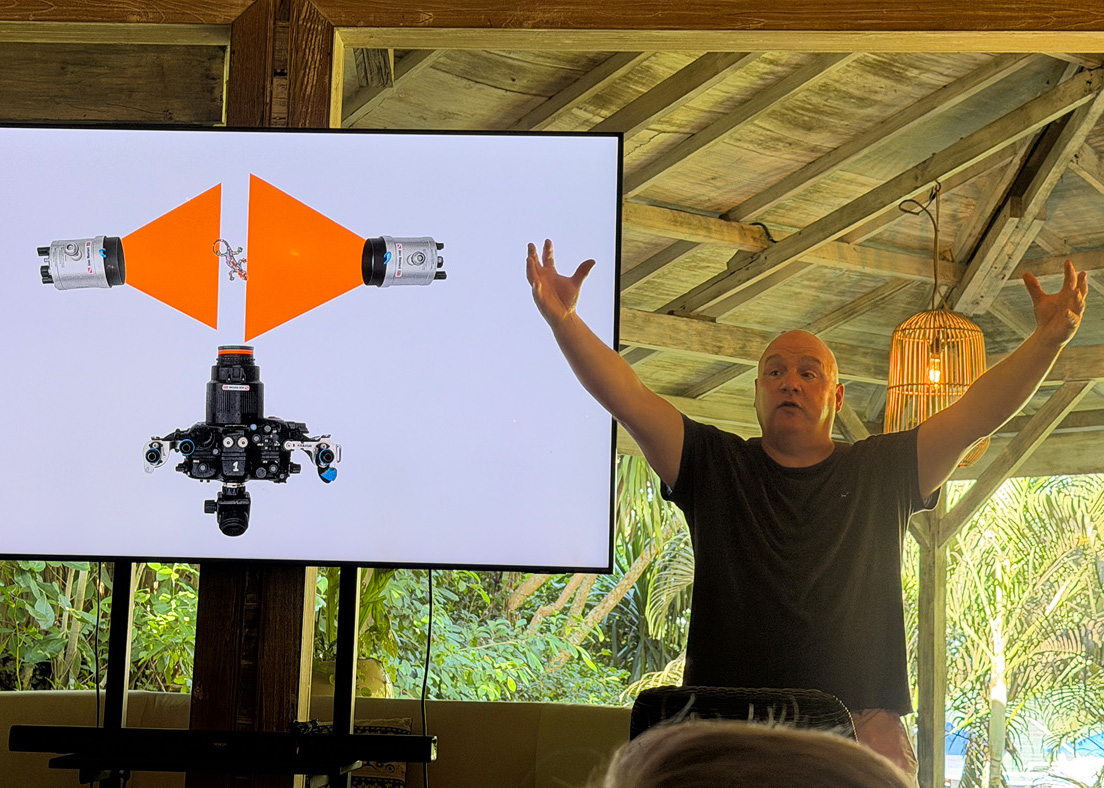
Below: Behind The Scenes In The Red Sea 2024
Teaching
My workshops are not aimed at absolute beginners. There are many photographers who can coach you through the basics. I aim to teach people who are already shooting, are enthusiastic about their photography and looking to take their photos to the next level. But my best teaching events are those where the photographers do have a range of levels. I promote and open, sharing atmosphere and I am proud that you will learn from me and from each other on all my workshops. Many of the big-name contest winners that you’ll meet on my workshops were beginners themselves when they first joined me, and remember how much advice from the group helped them. And I trust them to be just as helpful. All I ask you is that you are enthusiastic about your photography, not condescending to those behind you on the learning curve, and want to improve.
There is no minimum equipment requirement and non-photography partners are always welcome to take a place on the workshop. My workshops have always attracted many well known names from the contest winner’s circle, but you won’t find big egos, just enthusiasts (the egomaniacs prefer to travel alone). My workshop trips are typically intensive, but nothing is compulsory. I like to make the most of every day and you always have the option of skipping something.
I try and make my different workshops as diverse as possible. Many individuals join me on multiple workshops, so I attempt to vary the teaching focus on each, while not missing out telling you what is important. I am also aware that most people will have devoured my books before my workshops, so do not simply repeat the content from them. That said, I will always re-cover important topics and share what I feel is most valuable for you to know that day. My workshops are always very interactive. I don’t teach from a script, the exact content of each workshop always varies depending on who is attending, the questions the group asks and anything unexpected that the diving serves up. And even with the workshops that I run annually, the teaching content continues to evolve each time I run them. Which also keeps it interesting for me!
Teaching is typical in the form of illustrated talks, pre-dive tips, and group image review sessions. I am always happy to help one to one – where time permits – and I am renowned for my ability to diagnose and fix camera gear in the field. I do not teach underwater (apart from pointing you towards good subjects, or modelling in your pictures) as I have seen many times it results in confused messages and wasted time all-round. Many photographers comment they hear my voice advising them when they shoot anyway!
The key component of all my workshops is the diving, which is focused entirely on photography. I always try and give everyone as much freedom underwater as is possible and try to maximise the amount of time in the water each day. But I do ask the photographers on my trips to respect the marine environment as they shoot. And I try to set a good example in this. I always try and work as hard as I can to help you and your photography, and I think someone has always commented on how much energy I have on each of the 150 workshops I’ve done so far. I just find seeing marine life and helping people with their photography so energising.
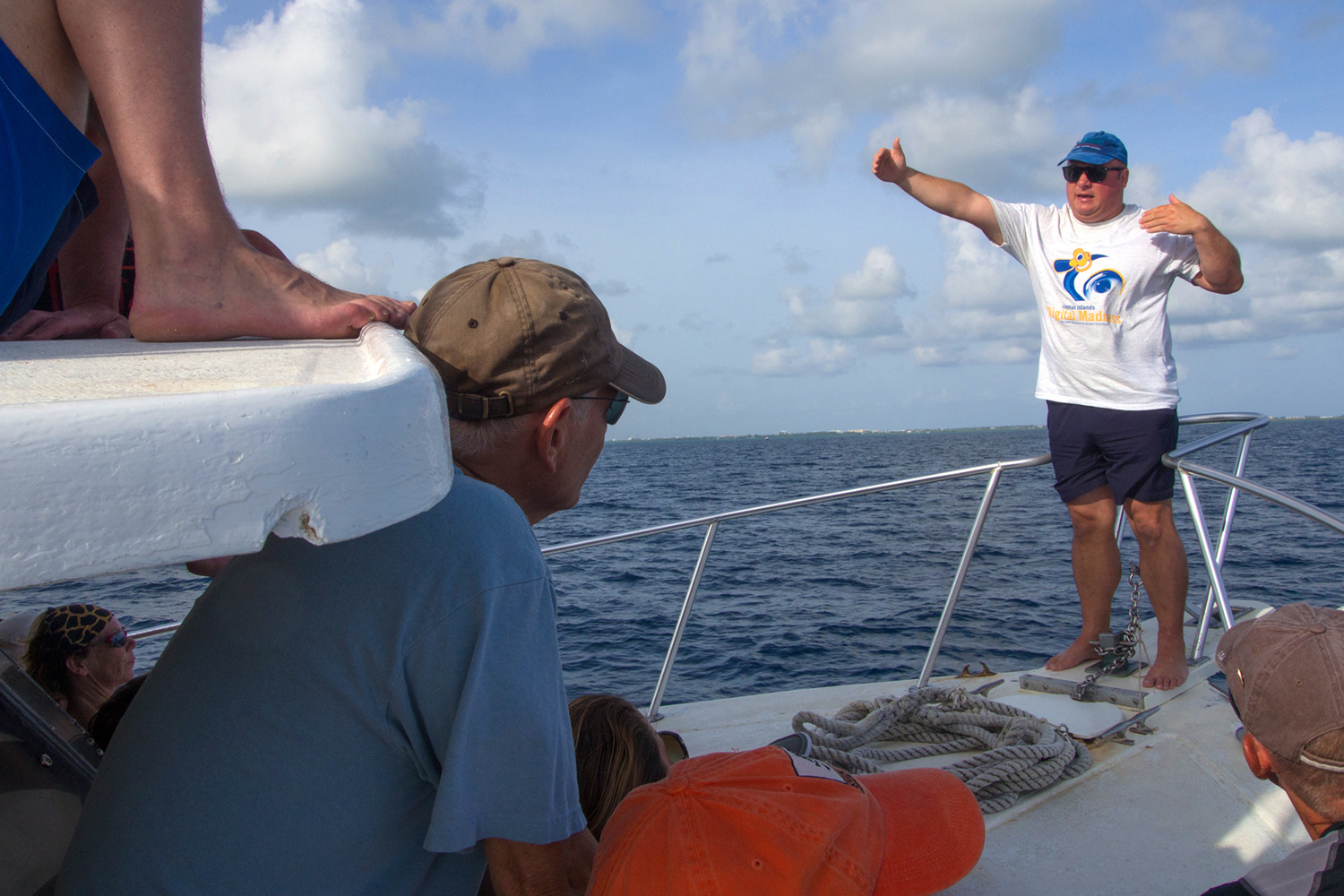
Below: Behind The Scenes In Raja Ampat 2024
Below: Red Sea Oceanic Whitetips 2019
Atmosphere
My workshops make the most of us being a group. Whole boat and resort bookings mean that we have full control over our dive site choices and schedule, tailoring it entirely for photography. It also means that you have a boat load of buddies who might just have that spare part you forgot, or be on hand to loan a strobe when yours breaks down. Sharing gear is entirely up to individuals – if someone is in need I will announce it to the group and people can decide if they want to help out.
More important than sharing gear is sharing knowledge and ideas. A fundamental part of my workshop philosophy is that there is NO COMPETITION. I prioritise a constructive and sharing atmosphere for everyone’s benefit. And just about everyone comments about how much they learn from others on the trips and I believe that this is a major reason why my trips have so many repeaters. The less experienced shooters have loads of people to learn from and by having to explain techniques, the more experienced really build a deeper understanding of their photography by having to explain it. People openly share images in review sessions than inspire others, and they in turn get inspired by other people’s shots – and everyone goes home with far more better images than they would have got traveling solo.
Although my workshops are taught in English, I am particularly proud that my workshops bring together underwater photographers from all around the world. All with different aesthetic tastes, different equipment and used to shooting in different conditions. It is a fantastic melting pot for ideas and I don’t believe there are any other events in underwater photography that regularly bring together photographers like this. It is something very special and means I learn new things on every workshop too.
I take photography seriously on the workshops, but not myself. So hopefully you’ll have a good laugh along the way. I want the workshop week to be thoroughly enjoyable and a place you feel you can be yourself. And of course, I want you to create fabulous images that you want to show off and consider entering in contests after the workshops. Over the last 20 years there has rarely been a set of international underwater photography contest results in that don’t have images taken on one of my workshops.
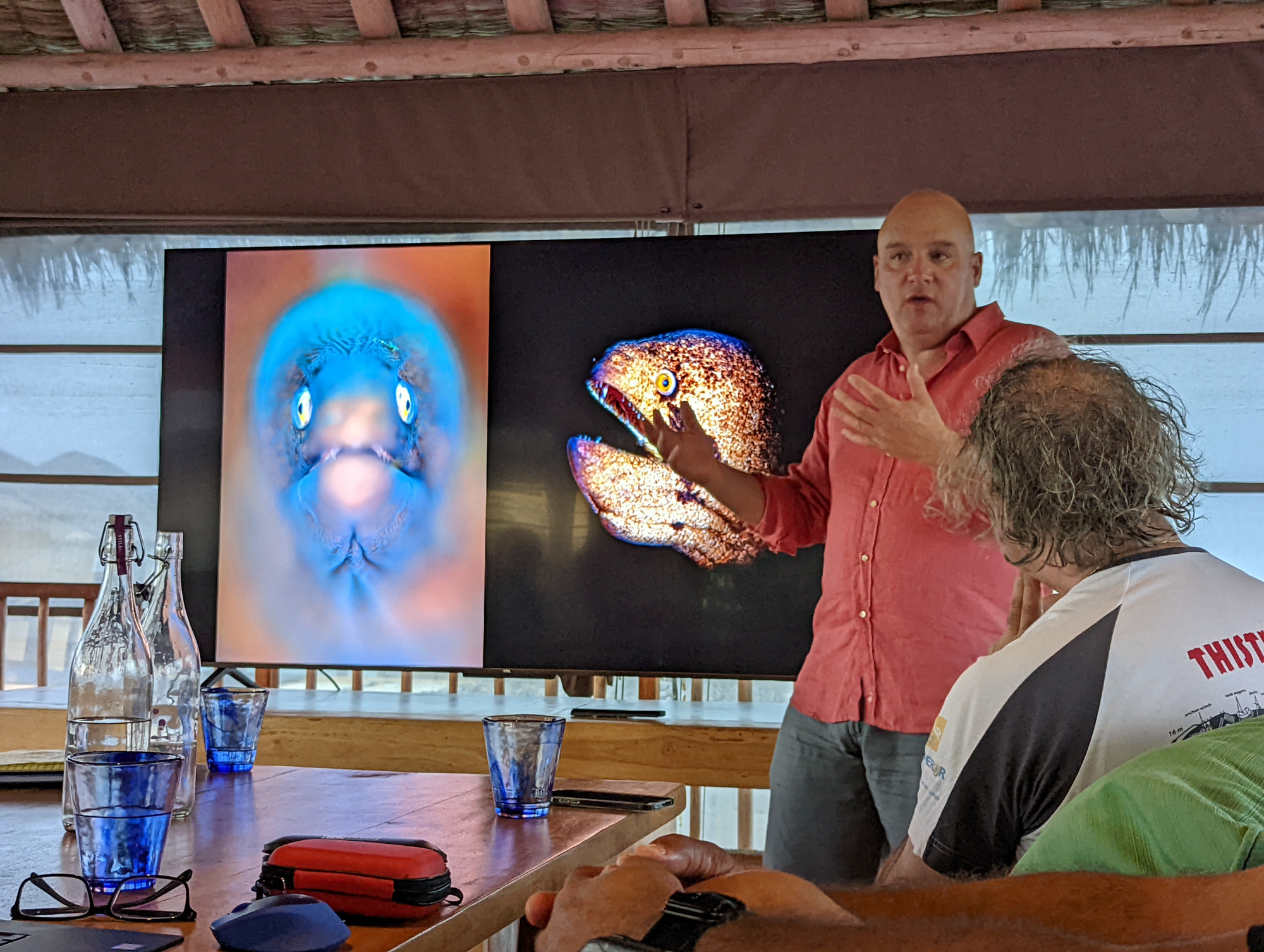
Below: Behind The Scenes In The Maldives 2025
Booking
My workshops are very popular, so to make it fair I announce my trips in an email newsletter – sent out by MailChimp. It is sent to everyone simultaneously – there is no pre-booking, no priority list. I usually send it out on a week day, after lunch UK time – which seems about the fairest time globally, with the most people awake! The newsletter will then direct you to a page on this website where I will have just posted the full trip details and booking details. Places are offered in the order the agent receives emails clearly expressing interest – not an auto-respond email simply saying “yes” (as has been tried!). The workshops typically fill up very quickly, however cancellations do happen and if you really want to make a trip get in touch as spaces inevitably come up. Since most of my workshops are fully booked they only time you will see me advertising spaces publicly is when we get late cancellations. I send about 5-8 of these announcement emails each year.
I will talk about future plans on workshops – or you can ask me what I have planned. You can ask for information about these trips before they open for bookings, but you cannot get in the queue for a spot until after the Newsletter goes out officially opening the trip. For those that have asked for it – please look at this page with tips for getting a place!
I never take your payments directly for my workshops. They are either booked with a registered travel agent (most often Scuba Travel, UK) or sometimes direct with the dive operation. I only get paid by the travel agent after the workshop has run. This also means that different trips have different contacts for bookings and price for the trip is given in the currency that they work in. Being from the UK many of my trips are priced in GBP, but Scuba Travel are very used to taking payments from all over the world.
Where to start
A common question is which workshop to do first. It is not that critical, but my annual Cayman and Red Sea wide angle workshops make the most sense. The Grand Cayman workshop has a focus on wide angle from the perspective of controlling light and building wide angle shots and is the best wide angle teaching workshop. There is excellent subject matter too, with walls, caverns, Kittiwake wreck, stingrays, macro and much more. This really gets people on the right track with their techniques. Many European based photographers start with me on the Red Sea workshops. Here, the teaching is more defined by the subject matter: wrecks, reefs and schools – showing how wide angle technique varies with subject. And again is focused on wide angle and gives a great introduction into the approach required for outstanding images. For macro, my standout teaching event is More Mustard In Lembeh. Lembeh offers, frankly, ridiculous numbers of photographic subjects and Nick and I pack in so much teaching into this event, it is a must do.
The more exotic workshops tend to be focused more on polishing your skills, rather than rebooting the fundamentals of your technique. So if you are relatively new, it makes sense to start with the annual trips, but an established shooter may want to drop straight into these more far-flung trips. Also consider signing up for my popular online course Underwater Photography Reboot, so you are primed and ready for my workshops. Please tune in to The Underwater Photography Show too – although Matthew and my conversations are intended as chats rather than detailed teaching.
End of week shows
My workshops usually finish with an end of week show, this is a private show of the trip that people can take home as a movie slideshow. I do not share these end of week shows online, but the video clips in the behind the scenes videos on this page do form parts of these shows. You can watch more online here.


