
This column about Hawksbill Turtles was written for the Fall 2026 issue of Alert Diver (USA). It is included here as an example of my marine life articles.
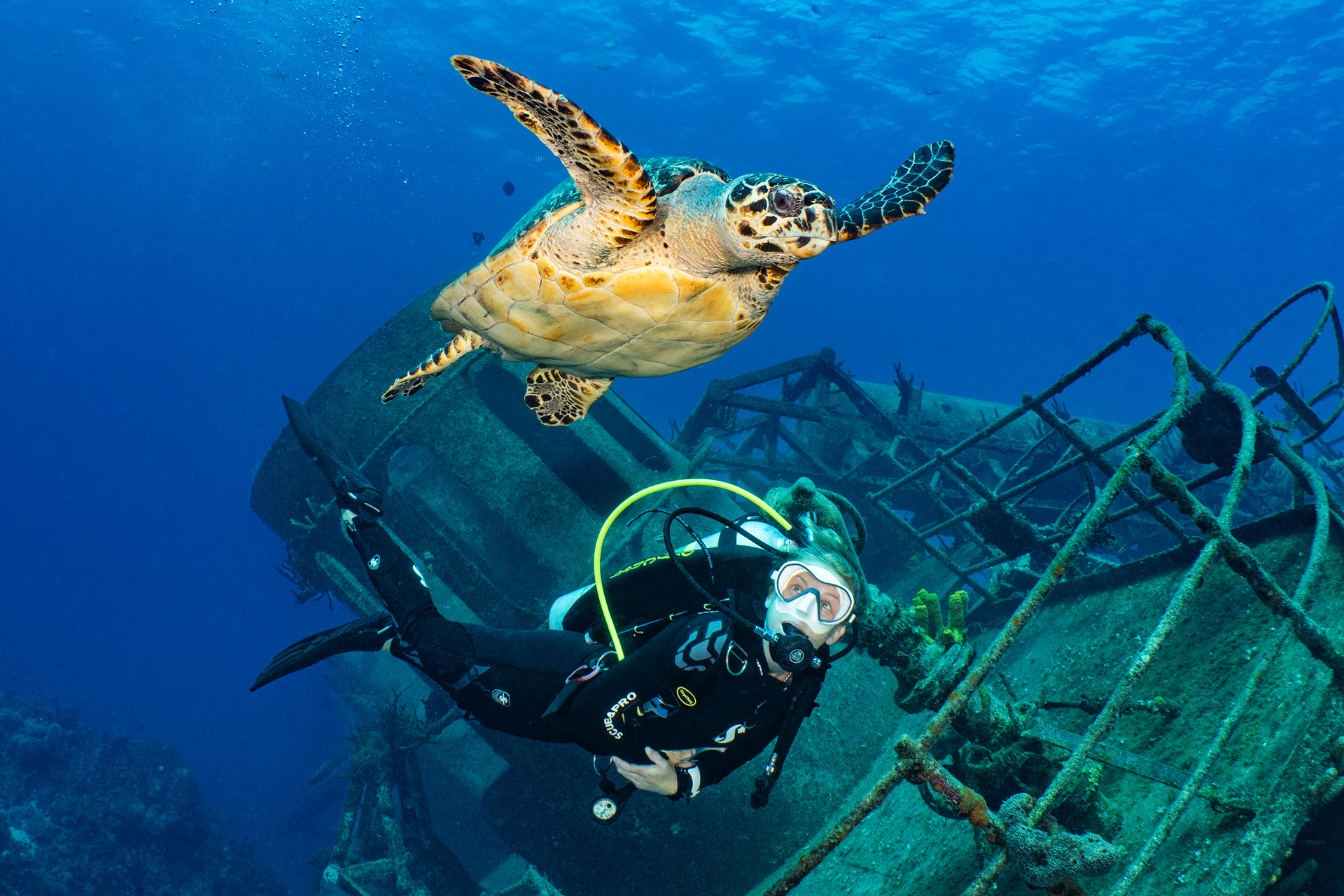
The wreck of the ex-USS Kittiwake in Grand Cayman is a crowd-pleaser of a dive. Now 15 years old, she lies atmospherically on her side, but is still easily explored inside and out. Rich, colorful sponge growth flourishes on the port side, which now faces down away from the sun. Platoons of parrotfish and tangs work the algae covered decks, sergeant majors make use of the smooth metal and lay their eggs on the superstructure, while stingrays and eaglerays are almost always spotted patrolling in the sand.
Today, though, my attention is very much focused on a hawksbill turtle that is gently sculling along the wreck. My buddy, Jess, and I accompany it, only peeling away as another dive group closes in. The hawksbill doesn’t seem to care as we enjoy watching the other divers’ eyes widen and bubbles increase in excitement. This turtle has clearly seen it all before, passing through the group and making a beeline for an outcrop of sponges. A few minutes later we spot a second, smaller individual also approaching the wreck for a snack, this one is a little shyer and swims a little faster to reach the shelter of the metal.
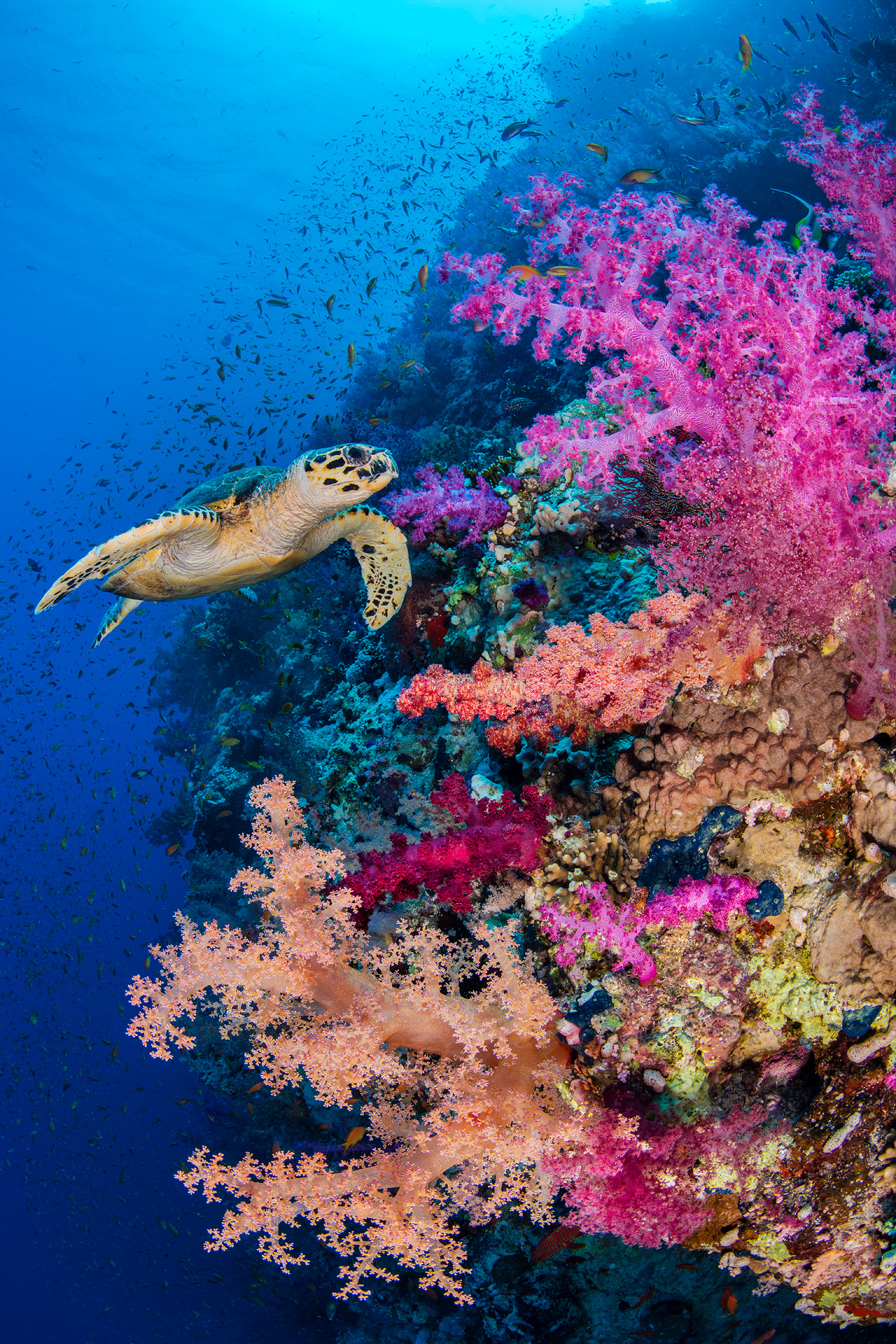
Divers enjoy encounters with hawksbills across the Caribbean and throughout the Indo-Pacific, from the Red Sea and South Africa in the west right around the globe to the west coast of the Americas. No tropical diver could claim hawksbills are an unusual sight, but they are always special one. Especially so, as we learn more about them.
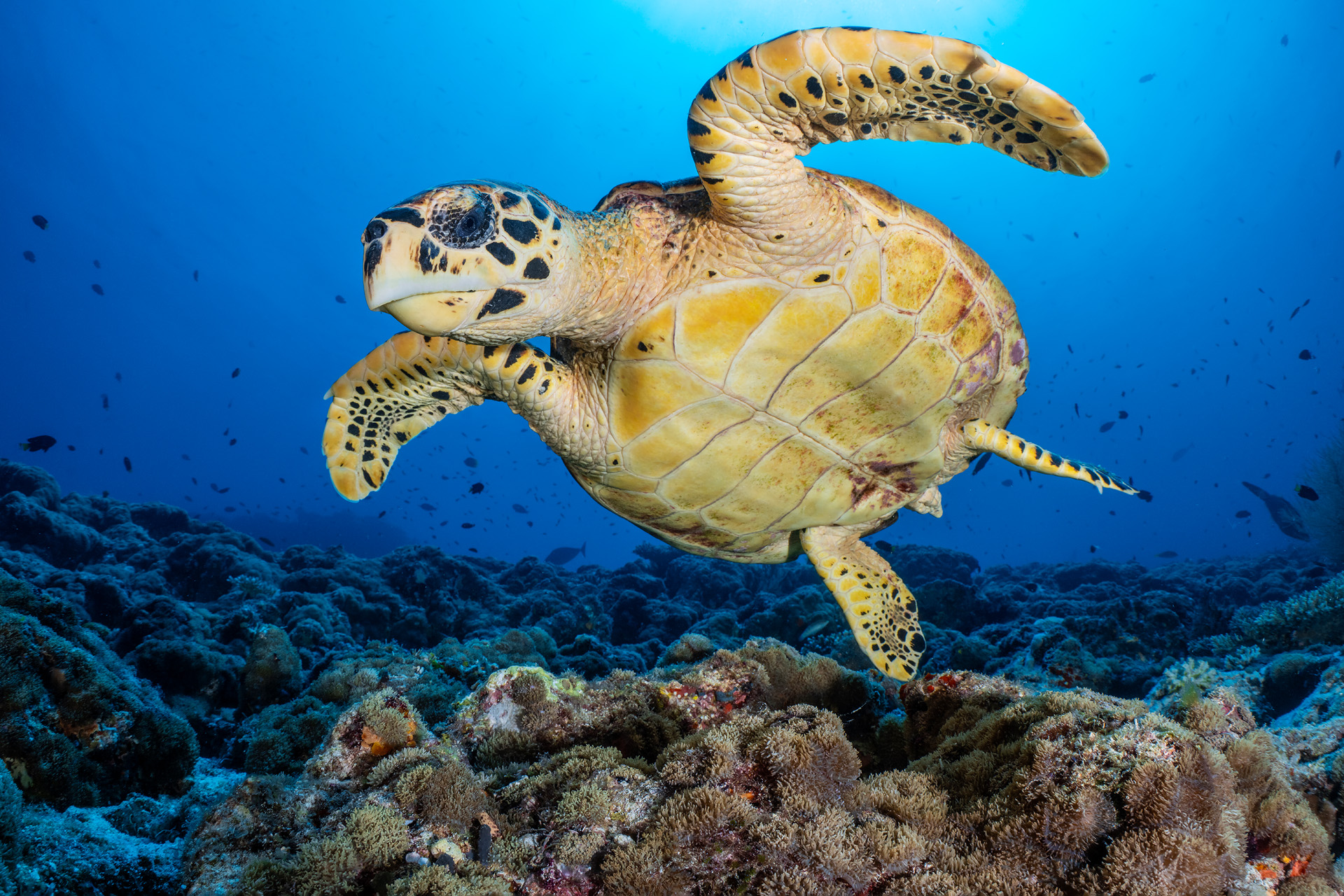
Hawksbills are found in all tropical seas
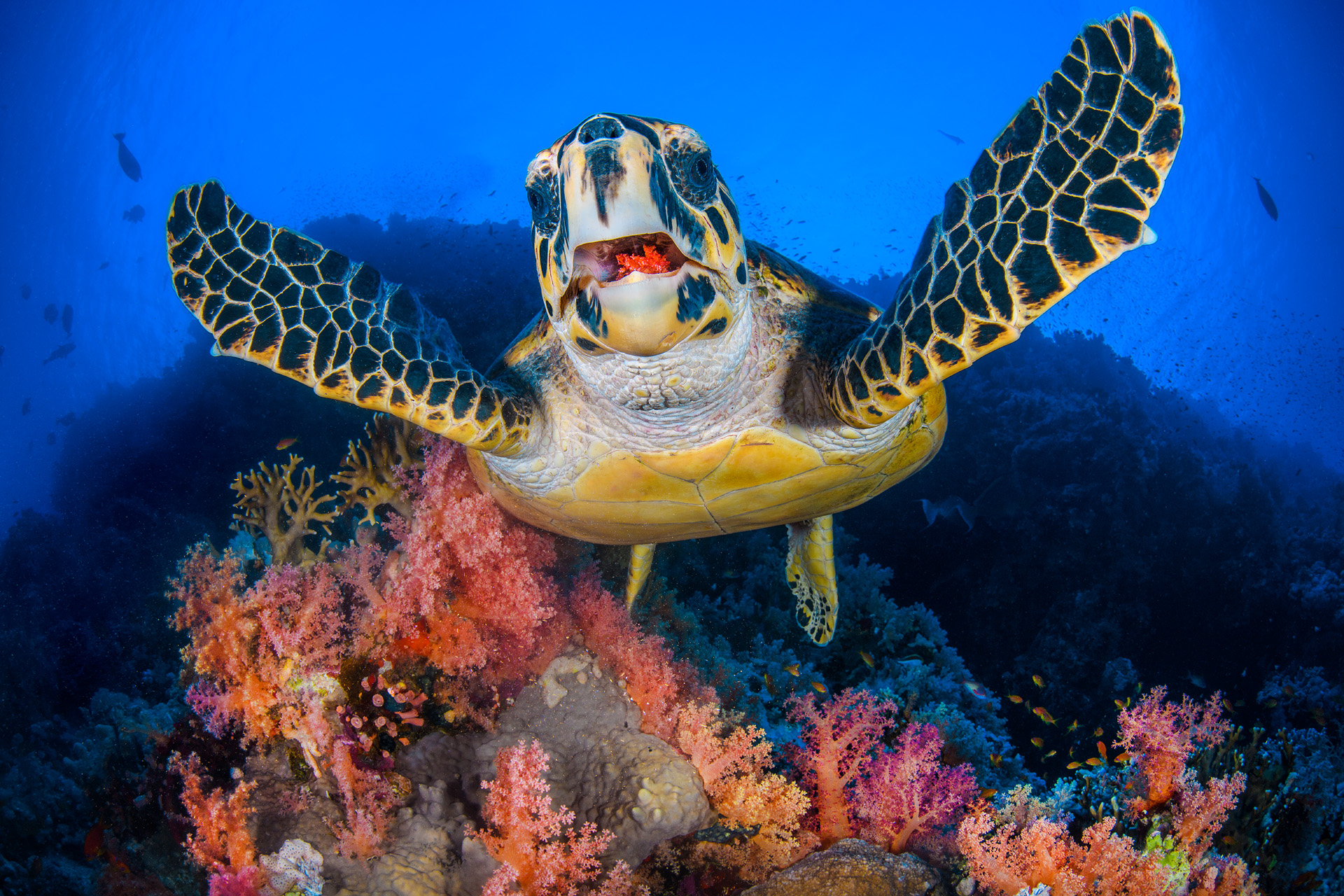
Hawksbills feeding

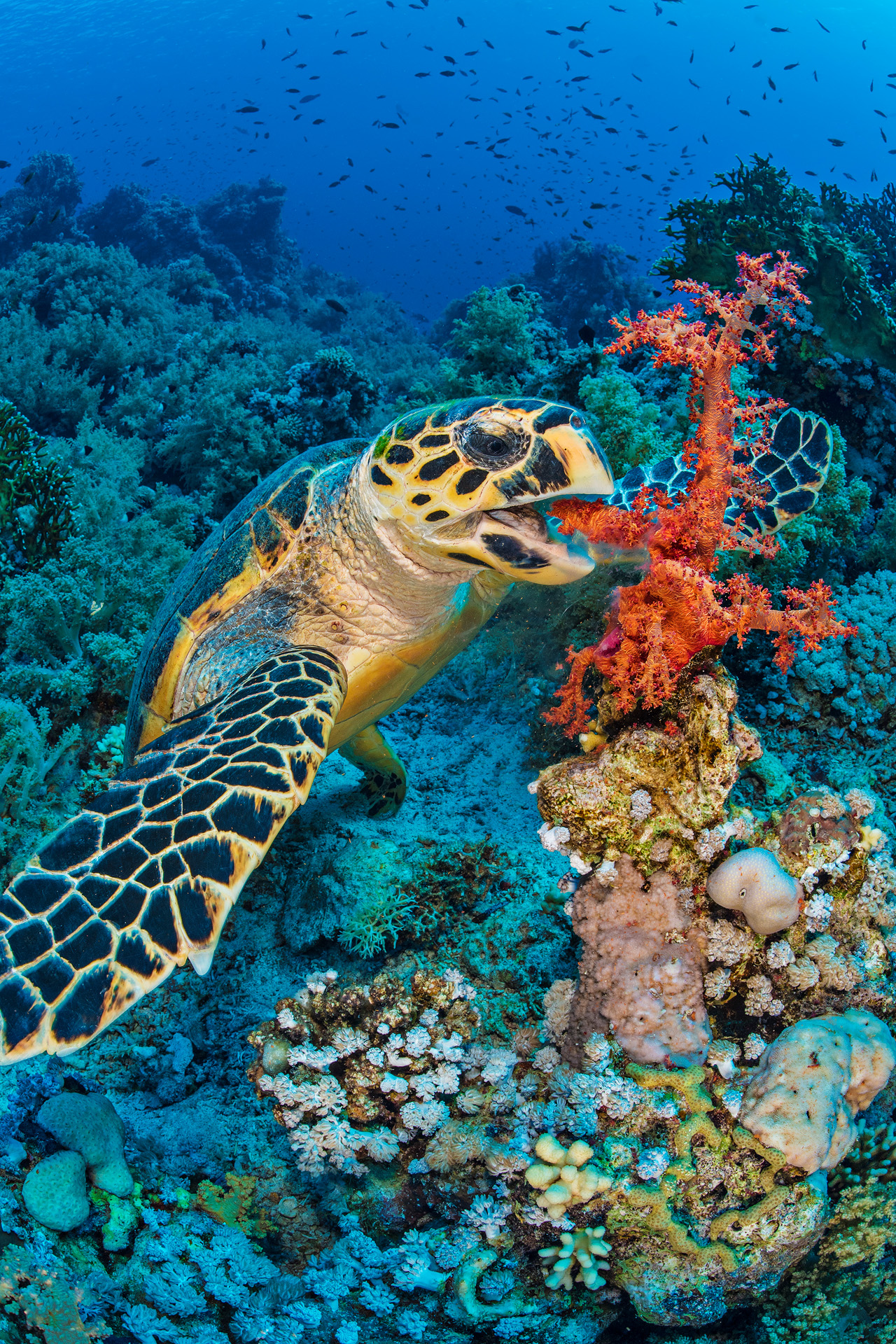
Caribbean hawksbills eat a lot of sponges, which is surprising really because sponges are laced with toxins and packed with tiny glassy spikes. Although their diet varies considerably from place to place, hawksbills seems to specialize in making delicacies of unpalatable, toxic, spiky and stinging marine life. Divers will commonly see them feeding on sponges, soft corals, jellyfish, corallimorphs, anemones and hard coral polyps. And they’ve also been reported eating algae, mollusks, tunicates, crustaceans, and even sea urchins. These turtles are single minded about their meals too. Even if you accidentally disturb one when it is feeding, wait around and it will usually head up for a few breaths of air and return right back to exactly the same sponge or soft coral.
In the Indo-Pacific, on hard coral dominated reefs, sponges often grow as an understory below branching corals, and you will regularly see hawksbills pulling the reef apart with their beaks and flippers to access them. Breaking apart the reef is good news for scavengers, and usually attracts a gang of wrasses, such as moon and checkerboard wrasses, hoping the commotion disturbs a tasty crustacean. Angelfish also eat sponges and often follow turtles around, benefitting from the hawksbill ripping through the outer layers with its strong beak. In the Caribbean, it is common to see French, gray and queen angels hanging out with feeding hawksbills, while in the Indo-Pacific I mostly see emperor angels taking over this role. The other association I enjoy involves the predatory cheek-lined wrasse, which I have seen in many locations across the Indo-Pacific using a hawksbill as cover. Most small reef fish ignore the benign presence of a hawksbill, and the wrasse exploits it, swimming in the shade just below its belly and darting when close enough to strike. In a few places this species of wrasse has learned to do the same trick with divers.
“hawksbills seems to specialize in making delicacies of unpalatable, toxic, spiky and stinging marine life”
Hawksbills share their range with green turtles and divers regularly confuse the two. Most guidebooks will tell you to focus on the details, hawksbills have overlapping scales on their shells, a more hooked beak and a square of 4 scales between their eyes, rather than 2. In my experience most divers never notice any of these things when they are enjoying a turtle encounter. The species have differences right across their bodies and it is much better to learn recognize them because of how they look, rather than any one detail. It is like saying you can tell my Mom from my Dad because she has longer eyelashes. True, but the bigger picture is more helpful.
Like all turtles, hawksbills hatch from eggs, that the mother lays high up on the beach, ideally under or near vegetation. Hawksbills favor small and isolated “pocket” beaches, with little sand and a rocky approach, usually in the same area that they were born. The females typically lay three to five nests through the summer, each clutch averaging around 150 eggs. Curiously, the sex of baby hawksbills is determined by the incubation temperature of the nests. On an unusually warm beach in Brazil, 90% of the hawksbill hatchlings were female. After about two months incubating, the hatchlings erupt from the sand at night and make their way to the water. They orient seaward by heading towards the brightest horizon – the ocean – and away from the darkness of land.
In the first few years of their life, hawksbills inhabit open ocean environments, taking shelter under drifting sargassum mats and feeding on a wide variety of food. Once they reach around a foot in length, at around 5 years, they head towards land, the reefs and their adult lives. Adult hawksbills are between 2 and 3 feet in length and weigh 100-150lbs. They are thought to reach maturity at around 20 to 35 years and are estimated to live 50 to 60 years, meaning if you return to dive in the same place down the years there is a good chance you’ve seen some individuals several times.
“On an unusually warm beach in Brazil, 90% of the hawksbill hatchlings were female”
Chances are, if you have done at least week or two of diving on coral reefs, you’ve seen a hawksbill. Most readers will have seen many. So, it usually comes as shock to divers to learn they are listed as Critically Endangered, the highest status before Extinction, on the official IUCN Red List.
To put this in context this is more at risk than the African elephant, any tiger or chimpanzee. Land mammals that have this same Critically Endangered status include the black rhino, the world’s rarest cat – the Amur leopard, and the Javan rhino, of which there are fewer than 76 in the wild. Hawksbills have around 8,000 nesting females remaining, but their population trend is still heading down. When I was younger they were simply Endangered, but a population decline of at least 80% over the last three generations set off the alarm bells. In 1999 they were moved to Critically Endangered and that was maintained in their last global population assessment in 2008.
As Stephen Frink said to me, “why is our perception so different from their reality?” Hawksbills are slow growing and long lived, but the concern is where the next generations are coming from. Quite a lot of the hawksbills that we see aren’t mature and probably won’t make it to breeding age. Hawksbills were heavily targeted for their beautiful ‘tortoiseshell’ carapace and caught for food. While the global tortoiseshell market has been curtailed they are still hunted by the Japanese bekko industry. The World Health Organisation warns against eating hawksbills, as their bodies are filled with sponge toxins that the turtle can cope with, but can cause kidney disease, liver cancer and even death in humans. Untargetted fishing is just as deadly. Many hawksbills are killed when they are unintentionally captured or tangled in fishing gear and drowned. Abandoned or lost gear, known as ghost-fishing, is just as deadly.
The other big issues comes as we develop the coast, where our activities mean that even if turtles live long enough to reproduce, they may not breed successfully. When we change wild beaches to human environments it disrupts the natural movement of sand between the sea, beach and dunes, typically leading to beach erosion. Beach erosion and the sea walls we install to prevent it robs hawksbills of suitable nesting habitat. Problems are exacerbated by our nocturnal light, noise and movement near these beaches, that can scare females away, or disturb them during nesting. Sadly, light is also a big problem for the hatchlings, which have evolved to head towards light, as the horizon over the sea is always brighter at night than the shadowy land. That is until we put electric lights on the land, disorientating the babies, causing them to die exhausted without even making the water.
Turtles have been in the oceans since long before T. rex stomped across North America. But hawksbills, though widespread are struggling in the Anthropocene. Partly this is because of active hunting of adults and eggs, but more so it comes inadvertently, as they die as by-catch or victims of ghost-fishing, or fail to spark the next generation as we disrupt nesting beaches. It always makes my day when a turtle cruises through my dive. So maybe we should return the favor and when we see a hawksbill we should be reminded to spread the word about bycatch, ghost-fishing and artificial light around nesting beaches. Hawksbill encounters are currently reasonably common and if we got the dive community talking about their challenges it could make a big difference for these ancient mariners.
“a population decline of at least 80% over the last three generations set off the alarm bells. In 1999 they were moved to Critically Endangered and that was maintained in the 2008 assessment”


