
I had such fun writing this column about underwater photography in the Red Sea, in the style of a Jeeves and Wooster story from PG Wodehouse, that I thought I’d share it here.
This is very a typical of my writing on underwater photography! It is the 55th instalment of my column Mustard’s Masterclass that I write for Scuba Diver magazine. Mustard’s Masterclass appears each month in the UK, Austral-Asia and German editions of the magazine.
What Ho, chums! Summer is here once more and in addition to breathing life and colour into the garden, it is also the time I traditionally bid farewell to Jeeves, grab a humorous softback, and decant myself onto a Red Sea liveaboard. The marvels of the R. S. in summer have long proved an inexorable draw to us snappers. This month, I’ve set myself the challenge of passing on Red Sea photographic insights, hoping to be as helpful as Tiresias was to Odysseus. Although I must also begin with sincere apologies to PGW for this mediocre facsimile of one of his lively summer reads.
Ra, the Ancient Egyptian god of the sun, is clearly a hardworking cove, on duty constantly from dawn to dusk in the cloudless desert sky. Combine this with visibility so dashed good that one suspects it surpasses even the clarity of the Drones Club’s Gin and T, and one has the perfect conditions for wide angle. Sprinkle into this cocktail a selection of stirring shipwrecks, reefs in their Sunday best, and a supporting cast of bally-impressive aquatic beasties, and you have a destination that would take a fellow of iron will to resist.
Although not our focus here, I’ll must mention that macro subjects are not exactly skulking in cupboards either in Egypt. The fish life is so used to divers that they flock around like there is talk of an open bar. Friendly fish and clear water make this topping territory for fish portraits. In short, this is a photographic paradise, a spot where many would auction-off a favourite aunt for the opportunities the Red Sea hands out before breakfast. When the feast is on the table, it is poor form to nibble at the parsley, and this month I want to help you to fill your belly and memory cards on your next Egyptian sojourn.
Throughout the Red Sea the reefs climb right up to the surface, like eager chaps trying to catch a pretty girl’s eye. The vertical walls positively fizz with life: red and pink soft corals doing their best impression of underwater fireworks, and clouds of anthias dancing above in a celebration of living colour. Set against that bright, almost electric blue water, the whole affair produces a colour scheme that could blast a chap’s socks clean off. Our job is to capture it in a picture.
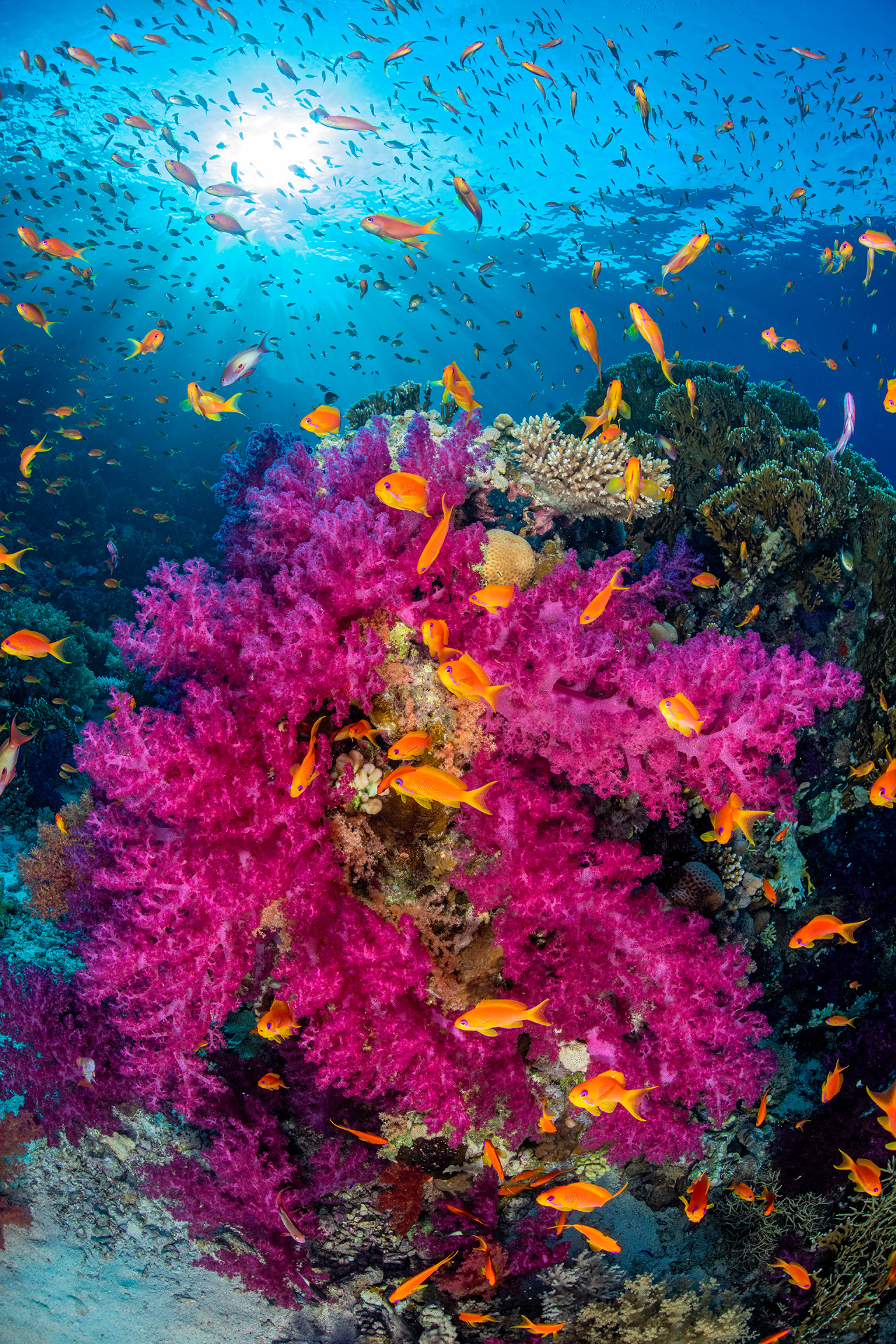
Build a scene around a striking subject
“this is a photographic paradise, a spot where many would auction-off a favourite aunt for the opportunities the Red Sea hands out before breakfast”
Successful reef photography starts with spotting the shot amid all this aquatic hullabaloo. If we try to cram the entire caboodle in the frame, the resulting photograph looks like Neptune has just tipped his sock drawer out on the carpet. The viewer is left bamboozled. Our aim is to simplify, as Jeeves succinctly puts it “be attracted by the scene, but find the subject within”. When we build a wide angle picture around a main subject, the scene is still in the shot, but the subject anchors the composition. Find that saturated soft coral, spiral of sea fan or graceful anemone as a centerpiece and then jostle the supporting cast into pleasing positions by small changes in your viewpoint and camera angle. You’ll find that once the trusty retainer is in place, the rest of composition comes easily and you are able to distil nature’s beauty into a clean, concentrated graphic image.
Artist and designer Andrew Loomis sums it: “the novice snaps his camera carelessly at nature, the artist seeks to arrange it.” Quite so. The business of simplifying the natural world into visually powerful images should be one of the central commandments of wide angle photography, carved on tablets and handed down to photographers working on the shores of Sinai.
It also pays dividends to work in background elements that give the image depth: perhaps a distant reef wall in silhouette, or a diver parked with suitable decorum in the blue. The world is three-dimensional, whereas photographs, alas, are a flat fellow with no more depth than a dive bore’s anecdotes. Wide angle compositions with depth are like a suit matched with the perfect tie, allowing a chap to stand out in the crowd.
The final flourish for wide angle scenes is including a hero fish. Red soft corals and anthias look stunning, but they are always improved with a large, colourful reef fish in the foreground to complete the tableau. Red coral groupers and yellow butterflyfish are ideal candidates; if one of these obliging chaps wanders in, welcome him like a long-lost schoolfriend.
“the whole affair produces a colour scheme that could blast a chap’s socks clean off”
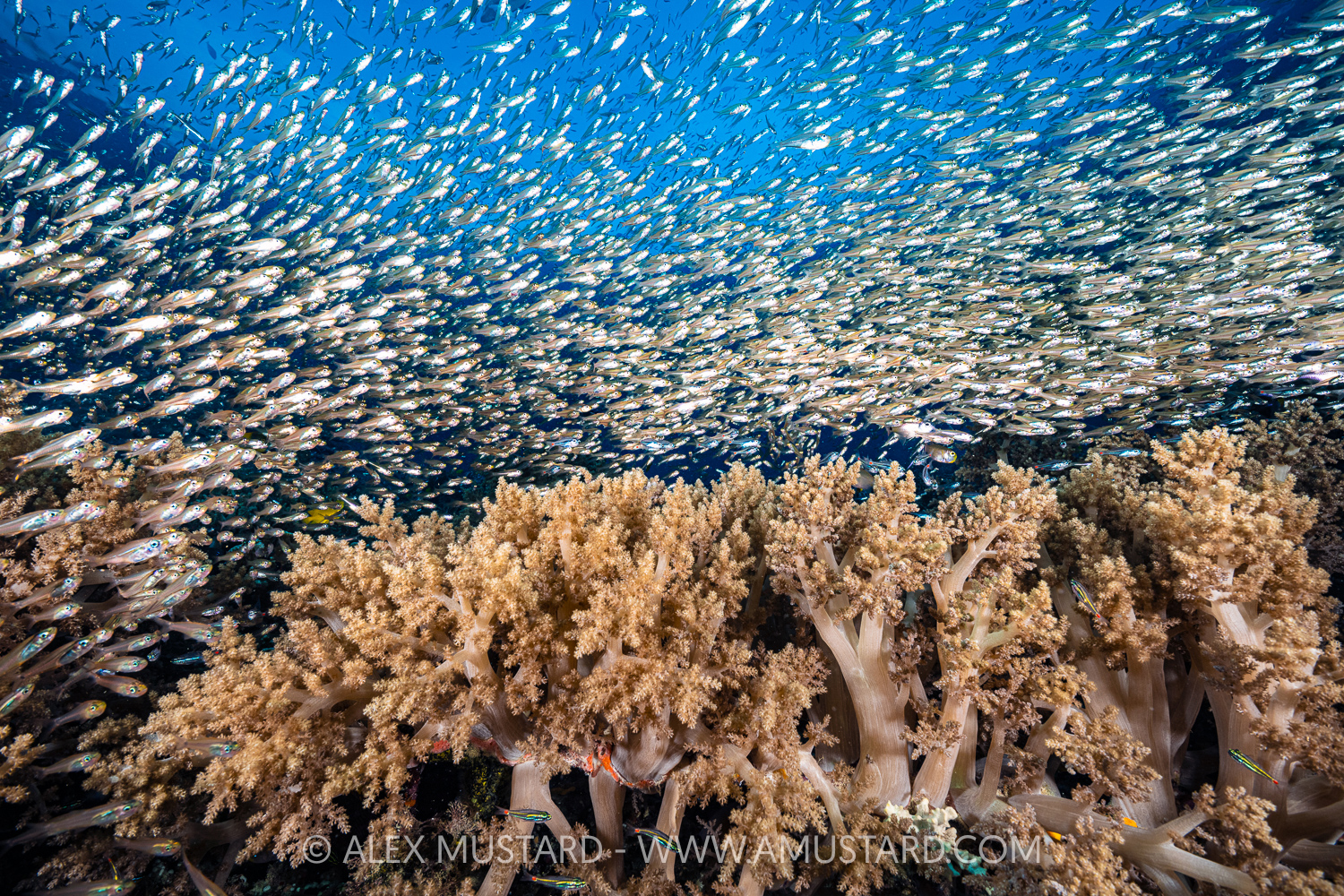
Many Red Sea reefs are also cut with caves and caverns, and the shallow ones are first-rate stages for light beams spearing down through the ceiling like theatrical spotlights arranged by a stage manager with a poetic streak. Prime time is close to midday, when the high sun shines deepest into the darkness. This is no time to arrive fashionably late for your appointment. Caverns are gloomy, so be ready to compromise all your exposure settings: raise the ISO, open the aperture and lengthen the shutter speed. Always better to compromise a little on them all, than pushing one of them too far.
As a general rule, the less we blaze away at a cave scene with our strobes, the more atmosphere the picture will possess. Switch the dashed things off, and only summon them if there is a subject genuinely worth lighting: such as a colourful coral or schooling glassfish. Our widest lenses are the stout fellows for these shots, opening up the space and allowing light beams to start and finish in the frame. Fisheyes are best, but add some bend. Most times this is fine, but if not they are a snip to correct in Lightroom, which can straighten their slouch with a click of lens correction, like a nephew after a word from a formidable aunt.
Turn off strobes inside coral caverns to capture the atmosphere..
“our widest lenses are the stout fellows for these shots, opening up the space and allowing light beams to start and finish in the frame.”
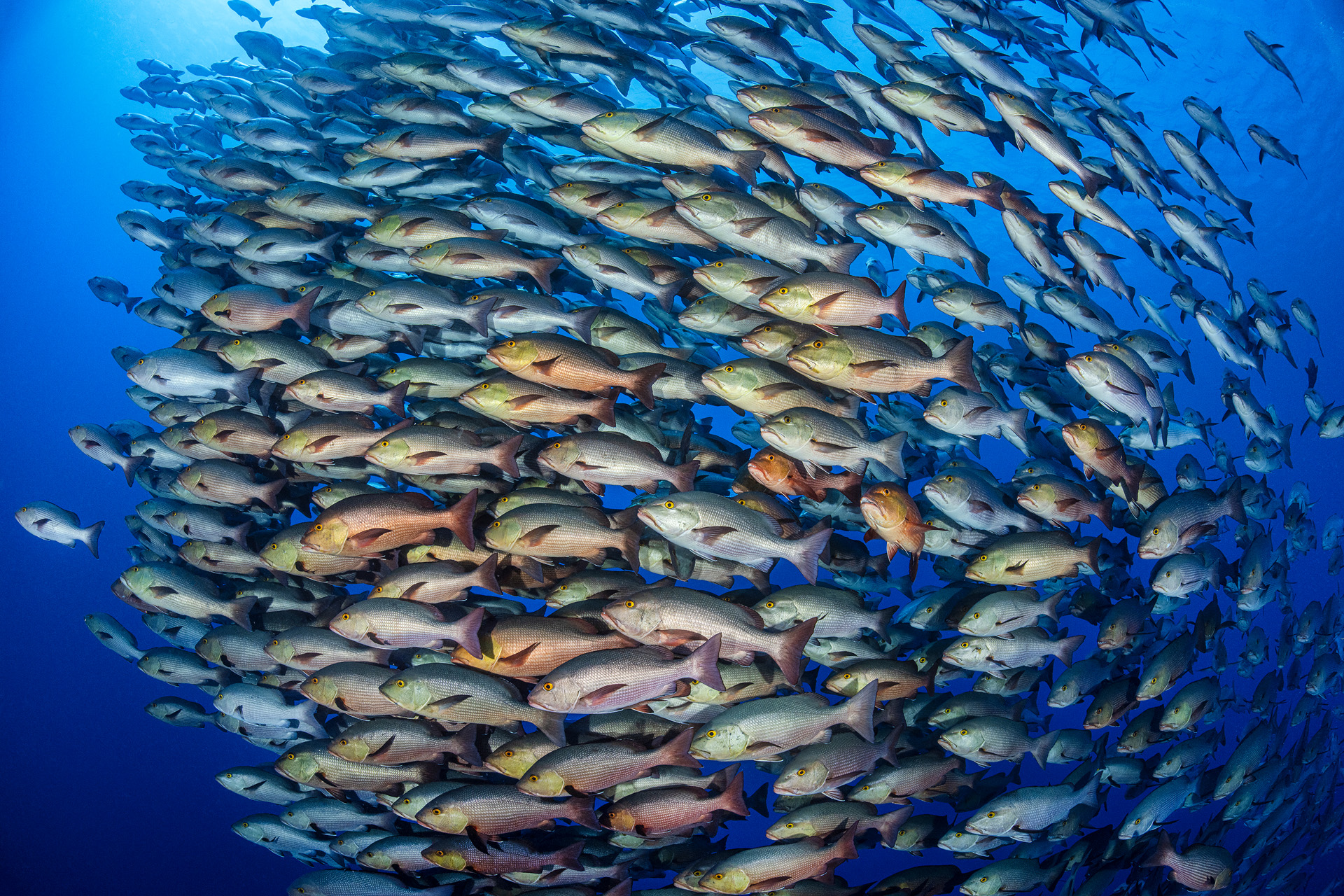
Don’t chase the fish, but let schools come to you for the best formations filling your frame.
“their moods are as changeable as a small terrier, switching instantly from lovingly licking its owner to ferociously feasting on your ankles”
The final great reef subject of the summer are schools of fish. Neat togetherness is the whole bally point of schooling; a shoal scattered about like hats after a boat-race luncheon never looks at its best. So more important than anything photographic, is keeping the fish in pleasing arrangement. To photograph schools well, we must temporarily unlearn one of underwater photography’s golden rules. The key is to remember Icarus and not to get too close.
Each species has its own ideas about personal space, and their moods are as changeable as a small terrier, switching instantly from lovingly licking its owner to ferociously feasting on your ankles. On some dives the fish seem positively magnetic, pulling together as if guided by Jeeves’ steady hand. On others they go higgledy-piggledy, pointing every which way, like a dive club committee deciding on next season’s club trip.
Current is usually our ally, lining the fish up and giving the whole outfit a proper direction of travel. It requires a little leg work, but the sound strategy is to swim upstream, give the school a generous berth, and then let the fish come to us as we drift back towards them. The reward is close encounters and great formations, the recipe for a stunning school shot. Pip-pip, chums. Long live summer.


